Paris, 1921–1926
A Moveable FeastParis, 1921–1926 is the period Ernest Hemingway’s book reconstructs as a life of close attention and material constraint: work was done in cafés and rented rooms, the city was crossed on foot, and poverty shaped ordinary decisions without erasing the couple’s sense of happiness. The account’s force comes partly from the distance between that remembered life and the act of remembering it. Its author identifies the years covered, acknowledges what has been left out, and allows the reader to treat the book as fiction even as it offers a light on what is recorded as fact.
Dates and the Memory of Paris
A note accompanying the book dates its subject to 1921–1926, but records its composition much later. Hemingway began writing in Cuba in autumn 1957, worked on the manuscript in Idaho during the winter of 1958–59, took it to Spain in April 1959, and returned with it to Cuba and Idaho later that year. He finished it in Cuba in spring 1960 after setting it aside to write another book, then revised it in Idaho in autumn 1960. The interval between lived experience and composition makes the city both a setting and an act of retrospective reconstruction.
The preface explicitly says that people, places, observations, and impressions have been omitted, whether they were private or already familiar to readers from other accounts. It therefore presents the narrative as selective rather than exhaustive. It also invites readers who prefer to regard the book as fiction to do so, while suggesting that fiction may still illuminate what is treated as fact. The book’s Paris is consequently neither offered as a complete record nor severed from factual experience: its authority rests in remembered particulars while its framing leaves room for uncertainty about how those particulars should be read.
Walking, Work, and the City
The narrator’s daily movement through Paris links observation to the discipline of writing. In winter, the first cold rains change the city in his account: its high houses recede from view, streets darken, and small shops close. Working in a top-floor room in the hotel where Verlaine had died, he considers buying kindling and wood but hesitates over the expense and the possibility that the chimney will not draw. Rather than risk wasting the fuel and money, he walks through the rain toward a café on Place Saint-Michel. The route is shaped as much by the cost of keeping warm as by the need to get out and think.
Walking also provides a practical way to work through problems. After finishing his work or trying to think something out, the narrator follows the quays and watches people doing tasks they understand. Near the head of Île de la Cité, below Pont Neuf, he observes fishermen working the changing currents and backwaters of the Seine with long jointed poles, light tackle, and carefully baited lines. He knows they regularly catch fish, including goujon, and describes their city fishing as serious and productive rather than the futile pastime some travel writers made it out to be. He does not fish himself: he lacks the tackle, prefers to save for fishing in Spain, and cannot predict when his writing will end or when he may have to leave. Watching the fishermen nevertheless makes him happy that people can fish in the city and take food home to their families.
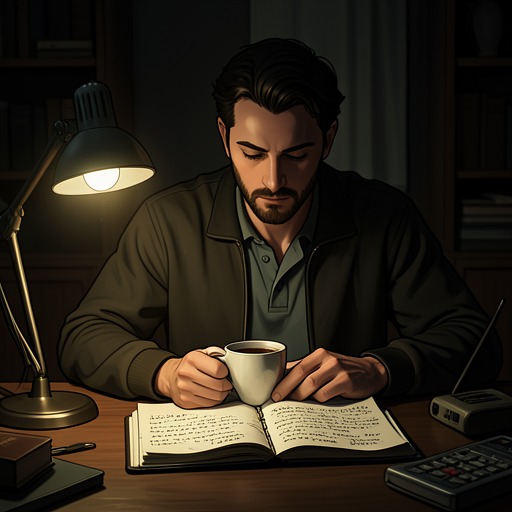
At the Closerie des Lilas, an afternoon writing session turns an uncertain ambition into a task. The narrator has concluded that he must write a novel, but resists doing so merely because it might provide regular income; instead, he plans to build toward the longer form through longer stories. In a corner, with the light over his shoulder, he writes in a notebook while a café crème cools on the table. The story concerns a return from war but does not mention the war. The scene makes the work’s method concrete: a remembered landscape and a river must be made on the page, while the experience that might seem to define the story is withheld from its surface.
Poverty, Appetite, and Shared Life
Economic limits govern daily choices without being equated in the narrative with misery. The narrator recalls being severe about money and recognizes that his wife had not complained about the hardships. A public bathhouse stood near their street, and ordinary comforts such as private baths and flushing toilets belonged to a different economic world. He remembers being wrong about the need for a grey lamb jacket, and describes thrift as part of an ongoing struggle in which not spending was the only reliable defense. Yet the couple did not think of themselves as poor: they regarded themselves as superior to people they mistrusted for being rich, ate and drank well at low cost, and slept warmly together. Their domestic plans likewise make modest means compatible with intimacy: a meal at home, inexpensive wine, reading, and time together form the evening they imagine.
Hunger alters not only what the narrator can afford but what he sees. When he has given up journalism and is writing work unlikely to sell in America, he avoids the food displayed in bakery windows and eaten at sidewalk tables by going to Jardin du Luxembourg, where the walk offers no such sights. At Musée du Luxembourg, he finds that being hungry sharpens the paintings and helps him understand Cézanne’s landscapes. He wonders whether Cézanne, too, had been hungry, then recognizes that this thought may be one of the unsound but illuminating ideas produced by hunger or sleeplessness. The episode presents deprivation as a condition that can intensify perception, without turning it into a simple virtue or denying its discomfort.
The Period’s Ending and Lasting Shape
The book’s final retrospective movement marks a change in the life it has recalled. The narrator describes a period alone with his wife in the mountains in which he worked well, they made trips, and he felt that they were invulnerable again. When they returned to Paris in late spring, the other difficulty began again, though the account does not specify it in this passage. He identifies this return as the end of the first part of Paris: the city remained itself, but the couple and their circumstances had changed. They never went back to Vorarlberg, and neither did the rich.
The ending refuses to make the remembered period a closed, recoverable world. Paris, the narrator reflects, has no final ending; each person’s memory of it differs, and people return despite changes in the city and in the ease or difficulty of reaching it. He concludes that Paris was worth what one brought to it, then narrows the claim to the particular years represented here, when he and his wife were very poor and very happy. That distinction gives the period its significance: it is not a timeless picture of the city but a personal interval whose meaning depends on both its material hardship and the later knowledge that it could not simply be resumed.